


Sundays
Information
Archive

































News
Info Archiv-Website
Welcome to the ohrenhoch archive website 2008 - 2019!
With the beginning of the Soundgallery 'ohrenhoch, der Geräuschladen' in 2008 we also started this website.
This website will not be updated from July 2019 and will be preserved as the original ohrenhoch archive.
- All presentations, artists, works in the Soundgallery since 2008 are documented here chronologically (or click on "Sundays since 2008" in the menu to the left)
- All projects / presentations of the ohrenhoch-Kids since 2008 are here
- The new ohrenhoch website is http://www.ohrenhoch.berlin
In der Zukunft war alles besser
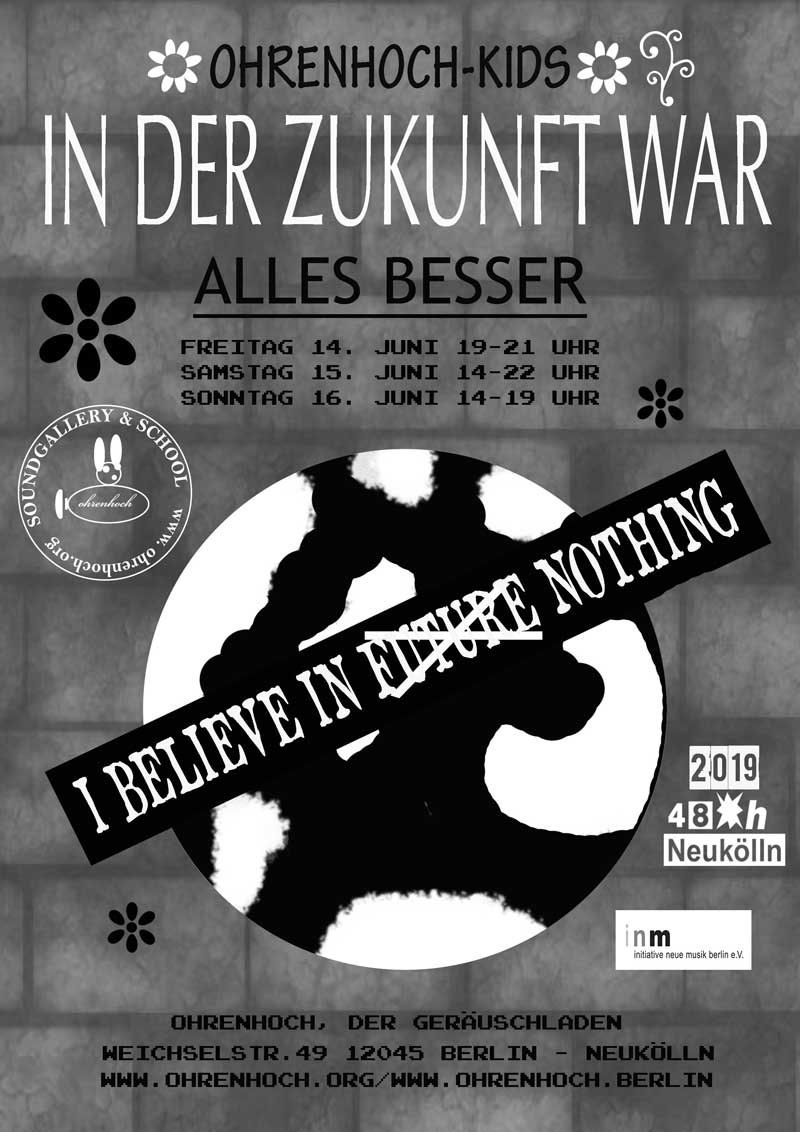
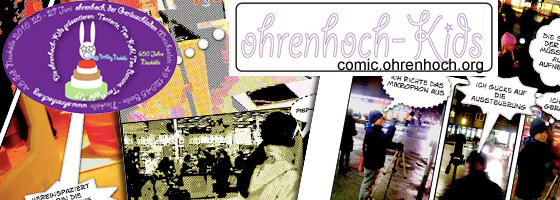
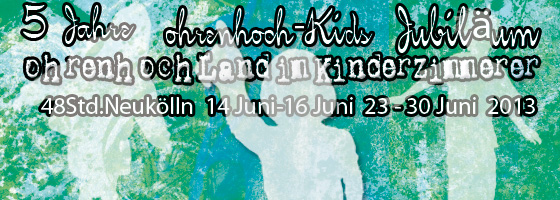
The ohrenhoch-Kids present at the Kunstfestival 48 Stunden Neukölln 2019 (Festival theme Future III), and on five more 'ohrenhoch Sundays':
In der Zukunft war alles besser
(In the Future, everything was better)
Friday 14 June: 19:00 - 21:00 Uhr
Saturday 15 June: 14:00 - 22:00 Uhr
Sunday 16 June: 14:00 - 19:00 Uhr
... and on the ohrenhoch Sundays
Sunday 23 and 30 June, 7, 14, 21 July 2019
'ohrenhoch - the Noise Shop' is a Sound Gallery for the presentation of international Sonic Art, and a School for children from 5 to 14 years old. ohrenhoch is located in Berlin - Neukölln.
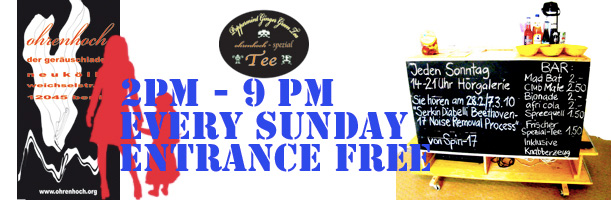
In the Sound Gallery, over a particular sound-architectural loudspeaker installation, every Sunday a fixed media work is presented in loop mode from 2pm to 9pm. A special focus is thereby on the perception of a single work, removing beginning or end of the piece.
In the ohrenhoch School, the ohrenhoch-Kids learn, research and experiment.
Starting from their own ideas they realise their projects with noises and sounds, on fixed media and with sound installations. The pedagogical basis is to meet the children at equal eye level and as fully-fledged members of the society.
The real meaning of life is to fathom moments of the eternal NOW / The ohrenhoch-Kids go backwards into the future / Creativity needs opposition.
„The world will be saved, if it can be, only by the unsubmissive.“
(André Gide)
"In der Zukunft war alles besser" is a production by the ohrenhoch-Kids with Knut Remond as their mentor
Acoustic Empire

To hear on Sunday 2 and 9 June, 28 July, 4 August 2019, 2pm - 9pm:
Acoustic Empire
A comment on Brexit.
Composed and produced
by Sylvia Necker
for the Sound Gallery „ohrenhoch“ Berlin, June 2019
Curator, loudspeaker installation: Knut Remond
Sylvia Necker on her piece 'Acoustic Empire':
On 23 June, 2016, the British held a referendum on whether leave or remain in the European Union. Ever since, the country has been deeply riven and no one knows how to resolve the tensions between the two camps. While the ‚remainers' still are hoping for a second referendum, ‚brexiteers‘ envision a new British empire. For the sound piece ‚Acoustic Empire‘ the German sound artist Sylvia Necker will set up sound routes along the trade routes of the British Empire. She will tie them in with contemporary debates, which she picked up in newspapers, radio programmes, and conversations with neighbours and colleagues in Nottingham. By merging these contemporary voices with the history of the British Empire, Necker acoustically comments on the Brexit process – a process that involves all of us either as British or as European citizens.
Neckers’ sound piece consists of two parts that emblematise two colonial trade routes of the British empire: Liverpool-Lagos and London-Dehli. The distance between the cities will equal the duration of the respective part: It’s 7,216 kilometres from Delhi to London and 5,261 kilometres from Liverpool to Lagos. So the two pieces will have a duration of 7:22 min and 5:26 min. The exhibition space of the sound gallery ‚ohrenhoch‘ will not only resonate political debates on Brexit but also sounds and music of the former colonies of Great Britain, to which Necker will add her own sound snippets played on electric guitar and synthesizers. At times the two sound routes – Liverpool-Lagos and London-Delhi – will intersect and produce an overlay, which becomes a metaphor for the various protagonists of the Brexit process, who are willing to drown out each other’s opinions.
Audio Field Report no. 46, soundactivism 25: Interview with Sylvia Necker by Knut Remond (April 2016). Limited edition audio cassette, 8 copies numbered. Available at 'ohrenhoch, der Geräuschladen' (and heard on headphone in the ohrenhoch archive space).
Sylvia Necker – a Nottingham (UK) and Frankfurt/Main (GER) based sound artist, curator and historian – , experiments with electronic music, field recordings, sound art, electro-accoustic sounds and free improvised music. Her preferred instruments are synthesizers, all kinds of electronic devices, piano, percussion and reeds. She has performed in theaters, museums and galleries such as „Heilig Blut“ (2018, Theater Landungsbruecken Frankfurt/Main), „Weisses Rascheln“ (2017, oqbo Art Gallery Berlin), „Muenchen Gollierplatz“ (2016, Ohrenhoch Art Gallery Berlin) and for the soundtrack of the photo work „Mischlinge (2015) by the New York based photographer Marc Babej.
Website Sylvia Necker
do not listen with half an ear
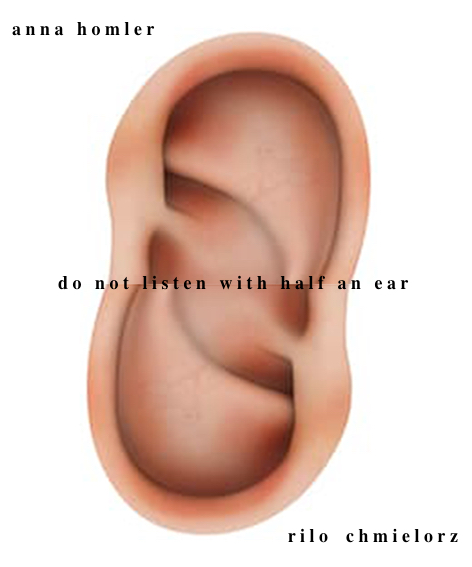
To hear on Sunday 5, 12, 19, 26 May 2019, 2pm - 9pm:
do not listen with half an ear
some listening-exercises
(2019, Premiere)
by Rilo Chmielorz, Berlin
and Anna Homler, Los Angeles
Curator, loudspeaker installation: Knut Remond
Rilo Chmielorz on 'do not listen with half an ear":
It is such a nice paradox: "Listening with half an ear!" There doesn´t exist half an ear. There is one ear or there are two ears. The linguistic paradox refers to an inattentive listening. An inattentive listening doesn´t fit at all to SOUNDACTIVISM. The OHRENHOCH-KIDS are right in telling us: "Hearing is work." Here comes the idea up of creating several miniatures - something like "listening-exercises " - titled:
DO NOT LISTEN WITH HALF AN EAR
It is an ironic, laconic lecture focusing feedbacks and parasites coming out of my acoustic casket and analogue sounds from the time when the reproducibility of sound was a new technical achievement such as a transistor-radio, catching the radio-waves flying all around us, and a phonograph. The latter one plays only "mono" - with „half an ear“ (?).
"Hearing is work" - we should practise. In times of media-overflow and discursive erosion our ears should be cleansed and our eardrums should have a massage. This is mainly the duty of the parasites and feedbacks - they are the masters of acoustic massage.
I sent some sound-pieces to Los Angeles. Anna Homler reacted on them:
Toys and voice were coming back from L.A. - and Anna wrote:
„In this project, one of sonic exchange, I tried to converse with Rilo's sounds.
Her soundscapes were very particular and I wanted to respond with very specific
sounds that created complement or contrast. This sound world is very
inviting to me and I hope others will enjoy it, too“.
And I wonder if Anna is telling us a fairytaile in a strange ancient, indigenous language of the hare, which denied to prick up his ears ….
There is no starting point and no end. The process is going on. Just like soundactivism.
An ongoing loop at „ear level“.
(Thanks to the OHRENHOCH-Kids Benjamin and Aila for their collaboration)
Rilo Chmielorz
is a multi-media-artist based in Berlin - working in the field of radio-art, soundart-compositions, radio-features and radio-theater as well as writing.
In 2002 she obtained the Production Award of the radio WDR, studio for acoustic arts within German Sound Art Award. Public and private collections include her work. She has presented countless individual exhibitions, concert/performances, and sound installations in galleries, museums and international music- and soundart-festivals in Europe, Mexico, Cuba and Hongkong.
Anna Homler and Rilo Chmielorz performed together in several occasions in Cologne in 2000 and 2002 at Joachim Zöpfs „WERFT“.
Anna Homler
is a vocal, visual and performance artist based in Los Angeles. She has performed and exhibited her work in venues around the world. With a sensibility that is both ancient and post-modern, Homler sings in an improvised melodic language. Her work explores alternative means of communication and the poetics of ordinary things. She creates perceptual interventions by using language as music and objects as instruments.
Website Anna Homler
Black Ice

To hear on Sunday 21 and 28 April 2019, 2pm - 9pm:
Black Ice
(2013)
by Maggi Payne
Curator, loudspeaker installation: Knut Remond
Maggi Payne on 'Black Ice':
This work is an exploration of space and time, and especially of depth and height. Layers frequently shift, as demonstrated in the beginning where crackling is so present—almost seeming to emanate from the listener. The underlay provides a distanced atmosphere, almost a nebula, that moves towards, through, then past the listener, passing through the crackles while modifying their molecular structure and turning them to mist as they slowly recede.
All of the sounds are generated by the Moog IIIP. Many are raw; some are further actively eq’d to provide a further dynamic quality to the work. It was composited using a Pro Tools DAW.
Although I’ve used bits and pieces of sounds I created using the Moog synthesizer in my work from time to time, in mid-December of 2013 I had an overwhelming urge to escape into the Moog IIIP studio at Mills College to spend some quality time generating sounds and recording them to a pair of Sound Devices. It‘s fascinating to me just how flexible that instrument is.
As with any fine instrument, it fundamentally remains the same, but the way one approaches the instrument changes considerably over time. Its open architecture has allowed quite varied aesthetic and technical approaches to the instrument over the decades since it was first built.
Audio Field Report no. 27 (February 2015):
Interview with Maggi Payne by Knut Remond. Limited edition audio cassette, 8 copies numbered. Available at 'ohrenhoch, der Geräuschladen' (and heard on headphone in the ohrenhoch archive space).
Maggi Payne
In her works Maggi Payne architects/sculpts the acoustic space so that the sounds build a geometric shape, then reorient, contract, or expand to an entirely different shape, shrink to a pinpoint, then stretch again to form yet another “world.” At times multiple spaces coexist. There is always a sense of “place,” an atmosphere, in these acoustic constructs. The sounds are choreographed, as if they are dancers in three-dimensional space, with no walls, ceilings, or floors to constrain them.
Her electroacoustic works often incorporate visuals she creates using images ranging from nature to the abstract. She has composed music for dance, theatre, and video, including the music for Jordon Belson's video Bardo. She collaborated for years with video artist Ed Tannenbaum in his Technological Feets performances.
Her works have been presented in the Americas, Europe, Japan, Hong Kong and Australasia. She received Composer's Grants and an Interdisciplinary Arts Grant from the National Endowment for the Arts, and video grants from the Mellon Foundation and the Western States Regional Media Arts Fellowships Program, and received five honorary mentions from Bourges and one from Prix Ars Electronica.
Works appear on Aguirre, The Label, Innova, Starkland, Lovely Music, Root Strata, Music and Arts, Centaur, Ubuibi, MMC, New World (CRI), Digital Narcis, Frog Peak, Asphodel, and/OAR, Capstone, and Mills College labels. Excerpts of her videos are available on Vimeo.
Website Maggi Payne
sic
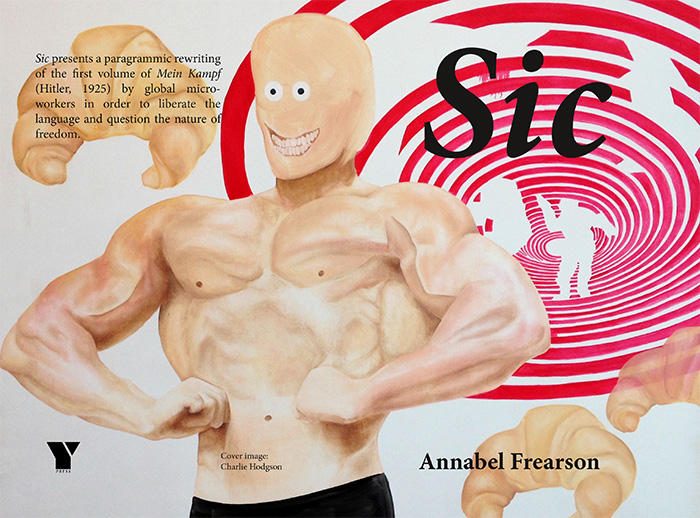
To hear on Sunday 24 and 31 March, 7 and 14 April 2019, 2pm - 9pm:
Sic
(2018)
by Annabel Frearson
Annabel Frearson reads Sic, a paragrammic rewriting of Mein Kampf by global micro workers, as a critique of contemporary fascism. A paragram is a verbal play that reorders the letters of existing words and phrases.
Thus, Sic intends to undermine Hitler’s text by rendering it deviant and to liberate the language contained therein by quite literally rewriting history. Sic enacts a material textual violence through an absolute dissolution of the original narrative and regurgitation as heterological mass comprising anagrams, disjunctive sounds and unspeakable interminglings of lettristic parts, rendering the antisemitic as antisemantic. The readings are recorded in a variety of contexts so as to re-entangle the liberated language with the material world.
Audio Field Report no. 11 (June 2014):
Interview with Annabel Frearson by Knut Remond. Limited edition audio cassette, 8 copies numbered. Available at 'ohrenhoch, der Geräuschladen' (and to hear on headphone in the ohrenhoch archive).
Annabel Frearson
My artistic practice is interdisciplinary, with a focus on expanded, conceptual art writing. I work with historically significant cultural objects, such as texts and films, through which I explore contemporary theoretical and socio-political concerns.
Recent publications include:
• Sic: commissioned by the International Literature Showcase (ILS), co-funded by British Council, Writers Centre Norwich and Arts Council England, comprising a paragrammic rewriting of Mein Kampf (Hitler 1925) by global micro-workers through online gig-economy platforms, as an exploration of contemporary fascism.
• Affectation Correspondence, Tombstone Press, 2017: A work of science fiction written using only words from Frankenstein (Shelley, 1831).
Exhibitions and projects have featured at: Camden Arts Centre, LUX/ICA Biennial of Moving Images, V&A Museum, Whitechapel Gallery, IMT Gallery, xero, kline & coma, London; Arnolfini, Bristol; Ikon Gallery, Birmingham; Haifa Museum of Art, Israel; ohrenhoch, Berlin; Shiraz Artist House, Iran; Golden Thread, Belfast; and Sheppard Fine Arts Gallery, Reno, USA.
I studied modern languages at Bristol University and fine art at Central St Martin's (UAL) and the Slade School, UCL. In 2014, I completed a PhD in art practice at Goldsmiths, University of London.
I teach art and critical studies at: Imperial College London; Goldsmiths College; Kingston University; Sotheby’s Institute of Art.
Website Annabel Frearson
Test Tube
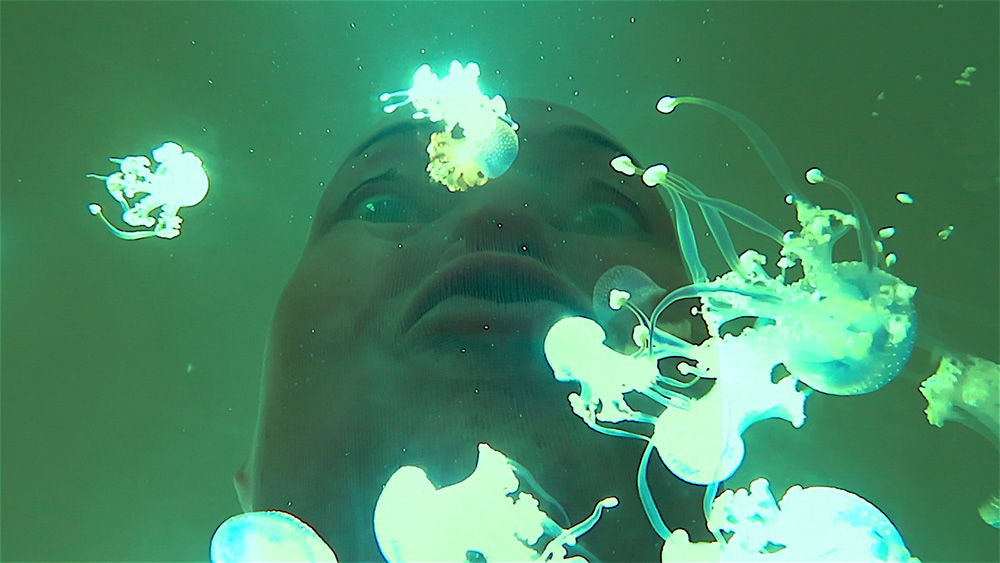
ohrenhoch presents on Sunday 24 February, 3, 10, 17 March 2019, continuously from 2pm to 9pm:
It grumbles, jerks and yearns...
Test Tube
artificial or real?
(2019, Premiere)
by Bernadette Johnson
Curator, loudspeaker installations: Knut Remond
‚Test Tube‘ is already the third new work for ‚ohrenhoch‘ by soundartist Bernadette Johnson (2013: „Playscapes, Take A: Beethoven in the Hills“; 2016: „Je suis in the Kitchen“)
Bernadette Johnson on 'Test Tube':
The development of systems which can recognize, interpret, process and simulate human emotions goes ahead. This provokes questions: Where is the difference between artificial and real? What happens to indefinable moods?
In „Test Tube“ the measurement of human emotions is the topic.
Sounds and noises from our everyday life, which draw, reform and manipulate subconces emotions, are collected. This audio material is nested, taken apart or condensed in sound balls. Spoken words describe a possible meaning.
Fictive scenarios and undefinable ambiances arise and disappear again. It grumbles, jerks and yearns...
In this interplay/counterplay of fragmented ambiaces, the borders between artificial and real are demanded and varied.
Audio Field Report no. 58 / Sound activism 37: Interview with Bernadette Johnson by Knut Remond. Limited edition audio cassette, 8 copies numbered. Available at 'ohrenhoch, der Geräuschladen' (and heard on headphone in the ohrenhoch archive space).
Bernadette Johnson
The Swiss Audioartist Bernadette Johnson lives in Basel. She is author of acoustical poems and audio pieces for Radio and other listening rooms. For her sound works she was awarded among others the Karl Sczuka Promotion Prize and was a laureate of Phonurgia Nova.In her audio-visual work as well, B.J. leads us through extra-semantic areas. Auditory perseption is observed, questioned and „disturbed“. It's a matter of tracing otherwise parallel and hidden experience spaces.
the black kite

To hear on Sunday 27 January 2019, 2pm - 9pm:
the black kite
by Knut Remond
for Christa my mother
(27 December 1931 - 22 January 2019)
www.ohrenhoch.org
next of skin | Unheard Life of Stones
Soundgallery: ohrenhoch-Sonntage
13 and 20 January, 3, 10, 17 February 2019, 2pm - 9pm:
2 works by Martyna Poznańska
Next of Skin
(2018) video
Unheard Life of Stones
(2018) stones, brass plate, transducers, electronics
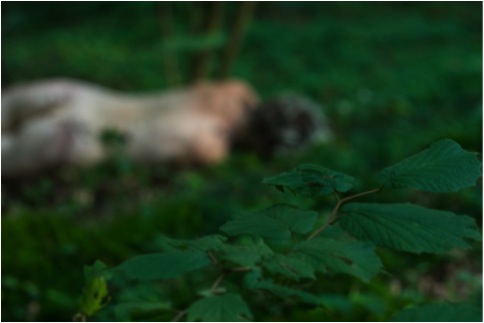
Martyna Poznańska on 'next of skin' [6:18 min.]:
'Next of Skin’ (2018) is a continuation of the work‚ ‚My Body Is The Forest, The Forest Is My Body’ (2017). It conceptualizes the relationship between human body and the body of nature treating them as one organism. Seeking to remove the boarders and searching for a sensitive, intimate and direct contact embraced in a reciprocate rhythm.
In this video Martyna wants to become a forest, to return her body to the natural environment, where it belongs. She lies down and gradually envelops herself with whatever organic matter her body encounters on its way.
She feels that, through this very physical and intimate experience of giving her body into the environment, she can perceive it from a closer and purer perspective.
It is an ongoing project in which Martyna is searching for new forms of connections with the environment using her own body and opening it to various textural intimacies.
Martyna Poznańska über 'Unheard Life of Stones':
The Unheard Life of Stones is a sound sculpture and an artificial environment, which intends to create movement within apparently immobile and solid matter such usually a stone is considered. Since the process of petrification and various stages of transition of stones most of the times exceed our own lifespan they are occult and imperceivable. We can only assume a stone which is not yet a stone or observes an already stone. The piece reflects upon perpetual processes which happen in nature without our knowledge nor participation due to our transient existence.
The stones excited with low frequencies reveal in an exaggerated way the atomic exchange between their bodies which are now intertwined in an uncanny and imposed dance.
Audio Field Report no.22:
Interview with Martyna Poznańska von Knut Remond, artistic director and curator ohrenhoch. December 2015. Limited edition MC Kassette, 8 copies numbered. To hear on headphone in the ohrenhoch archive space.
Martyna Poznańska is a cross-disciplinary artist who works with different media across disciplines, building connections between the intangible medium of sound and solid matter. This includes the practice of listening and field recording in tangent to working with various visual tools such as drawing, video, mixed media, found objects, and writing.
She has exhibited and performed internationally in shows at the Akademie der Künste, Berlin (DE), Deutsche Oper, Berlin (DE), Aperto Raum Berlin, among others. In addition, she has worked with renowned artists such as Hans Peter Kuhn (Übergang, Martin-Gropius-Bau Museum, Berlin, 2017), and Peter Cusack. In 2013 she was a recipient of a grant from the Polish Ministry of Culture.
Martyna completed a master’s degree in Spanish Language and Literature at Jagiellonian University in Krakow, Poland, 2010. She studied Sound Art at the University of the Arts, London (LCC/UAL). In 2016 she obtained an MA in Sound Studies at the Universität der Künste Berlin (UdK).
Martyna lives and works in Berlin.
Website Martyna Poznańska
Soundactivism
SOUND ACTIVISM
Since 2015 the theme SOUNDACTIVISM is taken as a basis for 'ohrenhoch, der Geräuschladen'.
SOUNDACTIVISM 2015 / 2016 / 2017: Texts by Isabella Zamboni & Knut Remond
SOUNDACTIVISM 2018 / 2019: Text by Elisabeth R Hager & Knut Remond
2015
- 4 and 11 January 2015: "Salt-Sculpting" sound installation by Martyna Poznanska (Germany, Poland)
- 18 and 25 January 2015: "Meine-Welt-Musik – 2. Symphonie" Op.148/2013 by Dieter Kaufmann (Austria)
- 1 and 8 February 2015: "Syria..as my mother speaks" by Christine Gedeon with sound artist Bent Bøgedal Christoffersen (USA, Denmark)
- 15 and 22 February 2015: "outcry" for Bassbox loudspeaker installation, by Knut Remond (Germany)
- 1 and 8 March 2015: "MOSCOW - (M)y Swo(O)ning (S)ends out (C)old (W)armth", by Elisabeth Schimana (Austria)
- 15 and 22 March 2015: "Black Ice" by Maggi Payne (USA)
- 29 March and 5 April: "Labor in the Territory of Hawaii, 1939" Installation for a single visitor, by Ludwig Abraham (Germany)
- 12 and 19 April: "Breathe Between the Lines / Atmen Zwischen Linien" - for Eric Garner, by Christopher DeLaurenti (USA)
- 26. April and 3 May: "Island" by Dean Rosenthal (USA)
- 10 and 17 May: "La rosa incarnata del suono" by Giuseppe Iacono (Italy)
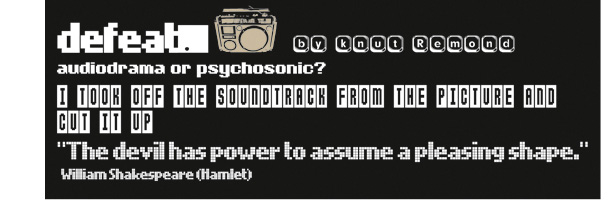
- 24 May: "defeat" - audiodrama or psychosonic? - by Knut Remond (Germany)
- 14 and 21 June: "pájaro suelto" sound installation by Rubén D'Hers (Germany, Venezuela)
- 26, 27, 28 June and 5 July: "unerhört" by the ohrenhoch-Kids (Germnay)
- 12 and 19 July: "AGNES, TINA, LION & MATHIS" by Alois Späth (Germany)
- 26 July and 2 August: Extension "AGNES, TINA, LION & MATHIS" by Alois Späth (Germany)
- 9 and 16 August: "This Is For You (ohrenhoch, Berlin)" Tina M Pearson (Canada)
- 23 and 30 August: "Submerged: Silent Service" by Louise K Wilson (UK)
- 6 and 13 September: "Why is why of no stranger" by Stelios Manousakis (Greece)
- 20 and 27 September: "Democracy isn't just a Tweet away" by Shelly Knotts (UK)
- 4 and 11 October, on the 25th anniversary of German Unity: "Bring on the Magic of Coca Cola" for tape, by Knut Remond (Germany)
- 18 and 25 October: "Melbourne Calls" by Viv Corringham (UK)
- 1 and 8 November: "aus den Papierwerken 1" by Volkmar Klien (Austria)
- 15 November: "unlimited" by Knut Remond (Germany)
- 22 and 29 November: "Cynical Fragments" by Prune Bécheau (France)
- 6 and 13 December: "Preparations for an Imaginary Conflict" by Cathy Lane (UK)
- 20 and 27 December: "Sprachgerüste, Sprachgelüste" by Laura Mello (Germany, Austria)
2016
- 3 and 10 January: "Ornaments II" by Ricardo Arias (Colombia)
- 17 and 24 January: "practice" by Yan Jun (China)
- 31 January and 7 February: piece without title by Patrik Lechner (Austria)
- 14 and 21 February: "Thinking of you (fragments)" by Gaël Segalen (France)
- 28 February and 6 March: "smash cars, and LOVE" by Knut Remond (Germany)
- 13 and 20 March: "Tinnitus Studies" by Hui Ye (China, Austria)
- 27 March and 3 April: "El Pozo" by Cecilia Castro (Argentina)
- 10 and 17 April: "The Kitchen sessions: 4AM" by Sol Andersson (Sweden)
- 24 April and 1 May: "MÜNCHEN GOLLIERPLATZ" by Sylvia Necker (Germany)
- 8 and 15 May: "RHO" by Anna Stereopoulou (Greece)
- 22 and 29 May: "pars stridens" & "sublocation" by Daniel Lercher (Austria)
- 5, 12 and 19 June: "Scorched Earth" (ohrenhoch remix 2016) by Lauren Sarah Hayes
- At the Art Festival 48 Stunden Neukölln and on the ohrenhoch Sundays 3 and 10 July: "ACTIVE COLORIZE" by the ohrenhoch-Kids and Knut Remond
- 17 and 24 July: "cozy new gastfeindlichkeit" by Julia Mihály (Germany)
- 31 July and 7 August: "Kindernacht", or "The Night of the Children" by Gisela Frick Hassenberg (Chile)
- 14 and 21 August: "You Will Understand It, When You Come Alone" by Eric Dickson (USA, Berlin)
- 11 and 18 September: "Dead or Ice Cream" by Knut Remond (Deutschland)
- 25 September and 2 October: "In the Throats of Trees" by Stephanie Loveless (Canada)
- 9 and 16 October: "acoustic turntable" by Andreas Trobollowitsch (Austria)
- 23 and 30 October: "Fehlberliner U-Wirr" by Jaap Blonk (Holland)
- 6 and 13 November: "Thinking of you (fragments)" by Gaël Segalen (France)
- 20 and 27 November: "Dry/Friction" by Khaled Kaddal (Egypt)
- 4 and 11 December: "Je suis in the kitchen" by Bernadette Johnson (Switzerland)
- 18 and 25 December: "Vote on Voting" by Yan Jun (China) & Mattin (Spain)
2017
- 1 January: Open door ohrenhoch Archive + information desk
- 8, 15, 22 and 29 January: "FUKUSHIMA 2011-2017" by Tetsuo Furudate and Tsutomu Otsuka (Japan)
- 5 and 12 February: "Salton Sublime" by Roxanne Varzi (USA)
- 19 and 26 February: "TRASH MUSIC" by Lucie Vítkovà (Czech Republic)
- 5 and 12 March: "untitled #337" by Francisco López (Spain)
- 19 and 26 March: "Ich Weiss Nicht (I Don't Know)" / "Deduction (Deduktion)" by Albert Raven (Netherlands, Berlin)
- 2 April: Open door ohrenhoch Archive + Information desk (Special: Audio Field Reports nos. 1-60)
- 9, 16, 23 and 30 April: FROZENTONES by Knut Remond (Germany)
- 7 and 14 May: "Canyons" by Elisabeth Schimana (Austria)
- 21 and 28 May, 4 and 11 June: "Distillation for Ohrenhoch (Spring 2017)" by Hans Grusel
- 18 June: "ShadowLifeSoundFlyerLoop" by Knut Remond, with the ohrenhoch_Rumori-Kids (Germany)
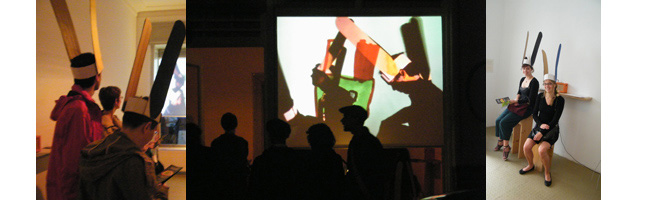
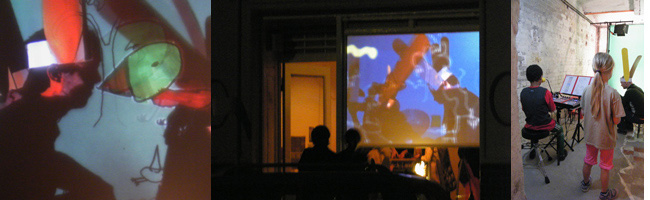
- At the Art Festival 48 Stunden Neukölln, 23 - 25 June, and on the ohrenhoch Sundays 2 and 9 July: "SHADOW LIFE", a project by the ohrenhoch_Rumori-Kids; concept, director: Knut Remond
- 16 and 23 July: "The Flux" by M4T & Kerta von Kubin (Italy, France)
- 30 July, 6 and 13 August: "The Antigone Project: After Sophocles (2013" by Gio Janiashvili (Tbilisi/Georgia; USA)
- 20 and 27 August, 3 and 10 September: "Temporal Feed" / "Gitmo List" by Liam Slevin (Ireland)
- 17 and 24 September: "To Heal a Broken Heart" by Gisela Frick - Hassenberg (Chile)
- 1 and 8 October: "The Greatest Thing You'll Ever Learn" by Gisela Frick - Hassenberg (Chile)
- 15 October: Open door ohrenhoch archive + information desk
- 22. and 29 October, 5. und 12. November: "A Social Harmony" by Ben Glas (USA)
- 19 and 26 November, 3 and 10 December: "State of Dread" by Stefan Gec, Andrew Stones, Louise K Wilson
- 17, 24, 31 December: "uma's position" Joint composition by Kornelia Bruggmann (Switzerland) and Knut Remond (Germany, Switzerland)
2018
- 7. January: "uma's position" joint composition by Kornelia Bruggmann (Switzerland) and Knut Remond (Germany, Switzerland)
- 14, 21, 28 January and 4 February: "SYN" by Anna Stereopoulou (Greece)
- 11, 18, 25 February and 4 March: "SIC" by Annabel Frearson (England)
- 11, 18, 25 March and 1 April: "Vast Territory - Episode 2 Forest Murmurs" by Elisabeth Schimana (Austria)
- 8, 15, 22, 29 April: "Absorb" by Tina Pearson (Canada)
- 6, 13, 20, 27 May: "Nowhere Close" by Gaël Segalen (France)
- 3, 10, 17 Junie 2018: "Am I Here?" by Cathy Lane (UK)
- At the Art Festival 48 Stunden Neukölln 22 - 24 June and on the ohrenhoch Sundays 1, 8, 15 July: "ECHTUNECHT" ("REALUNREAL") by the ohrenhoch_Rumori-Kids and Knut Remond (Germany)
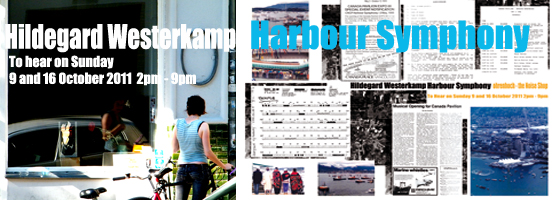
- 22 and 29 July, 5 and 12 August: "Once Upon a Time..." by Hildegard Westerkamp (Canada)
- 19 and 26 August, 2 and 9 September: "ROMA" by Cecilia Castro (Argentina)
- 16, 23, 30 September and 7 October: "2kampf" by Kornelia Bruggmann, (voice) and Knut Remond (composition). Text from 'ernst macht ernst', Episode 80, by Balthasar Kübler
- 14, 21, 28 October and 4 November: "May you find" by Hans Kämmerer (sound art) and Charis Nass (text and voice) (Germany)
- 11, 18, 25 November and 2 December: "the black kite" by Knut Remond (Germany, Switzerland)
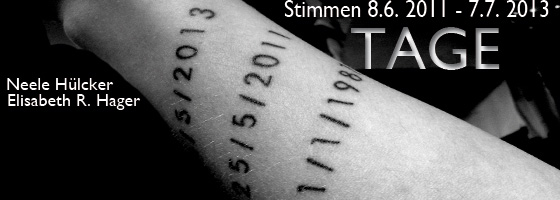
- 9, 16, 23, 30 December 2018, 6 January 2019: "TAGE" by Neo Hülcker and Elsabeth R. Hager (Germany, Austria)
2019
- 13 and 20 January, 3, 10, 17 February 2019: "Next of Skin", "Unheard Life of Stones" by Martyna Poznanska (Poland, Germany)
- 27 January: "the black kite" for Christa, by Knut Remond (Switzerland, Germany)
- 24 February and 3, 10, 17 March: "Test Tube" by Bernadette Johnson
- 24 and 31 March, 7 and 14 April: "SIC" by Annabel Frearson (England)
- 21 and 28 April: "Black Ice" by Maggi Payne (USA)
- 5, 12, 19, 26 May: "do not listen with half an ear" by Rilo Chmielorz (Berlin) and Anna Homler (Los Angeles)
- 2 and 9 June, 28 July, 4 August: "Acoustic Empire" by Sylvia Necker (UK, Germany)
- At the Art Festival 48 Stunden Neukölln 14 - 16 June and on the ohrenhoch Sundays 23 and 30 June, 7, 14, 21 July: "In der Zukunft war alles besser" ("In the Future everything was better") by the ohrenhoch-Kids and Knut Remond (Germany)
PLEASE ALSO VISIT OHRENHOCH ON THE NEW WEBSITE ohrenhoch.berlin


Förderer


Sponsoren